


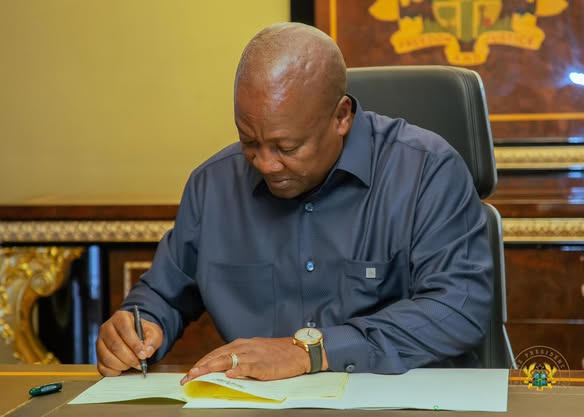
President John Dramani Mahama has assented to five new bills into law, marking significant reforms across Ghana’s national security, education, and financial sectors.
Among the newly enacted legislation is the Security and Intelligence Agencies Act, 2025, which introduces sweeping changes to the country’s security architecture.
The law empowers the President to designate a minister to supervise the National Security Coordinator, while abolishing the substantive role of Minister for National Security. It also rebrands the National Investigations Bureau (NIB) as the Bureau of National Intelligence (BNI), reflecting a shift in operational focus.
In the extractive sector, the Growth and Sustainability Levy (Amendment) Act, 2026 reduces the levy imposed on gold mining companies from 3 percent to 1 percent. The move is expected to ease the financial burden on mining firms and potentially boost investment in the industry.
The education sector also saw a major development with the passage of the University of Engineering and Agricultural Sciences Act, 2025. Introduced by Education Minister Haruna Iddrisu, the law establishes a new public university. The institution will have its main campus located in Bunsu in the Eastern Region, aiming to expand access to specialized higher education in engineering and agricultural sciences.
Additionally, the Ghana Deposit Protection (Amendment) Act, 2025 strengthens the mandate of the Ghana Deposit Protection Corporation. The amendment enhances its ability to protect depositors against financial losses in the event of the collapse of a licensed financial institution, reinforcing confidence in the banking sector.
Meanwhile, the Education Regulatory Bodies (Amendment) Act, 2026 introduces stricter requirements for tertiary institutions. Under the new law, all existing institutions affiliated with mentoring universities must obtain a charter within six years, a measure designed to improve standards and accountability in higher education.
The passage of these bills underscores the government’s ongoing efforts to implement structural reforms aimed at strengthening governance, economic resilience, and educational development in Ghana.