

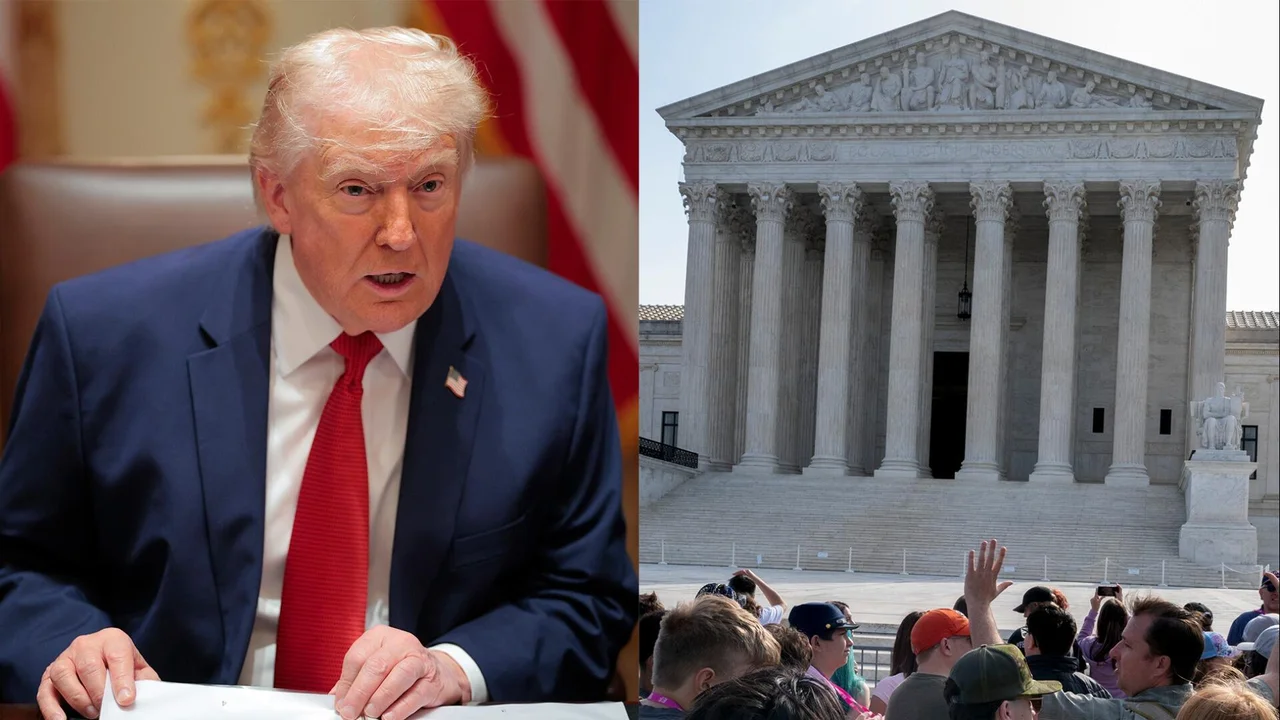
The United States Supreme Court has ruled that children born on American soil are constitutionally entitled to U.S. citizenship, rejecting an attempt by President Donald Trump to end the country’s long-standing birthright citizenship policy.
In a 6–3 decision, Chief Justice John Roberts, writing for the majority, held that children born in the United States to parents who are unlawfully or temporarily present in the country are citizens at birth under the 14th Amendment of the U.S. Constitution.
The ruling deals a significant blow to President Trump’s immigration agenda after his administration sought to restrict birthright citizenship through an executive order. The order argued that children born to undocumented immigrants and certain temporary visitors were not “subject to the jurisdiction” of the United States and therefore should not automatically qualify for citizenship.
Five justices, including Chief Justice Roberts, concluded that the executive order was inconsistent with the Constitution. Justice Brett Kavanaugh, in a separate opinion, also maintained that the order violated federal law.
The decision reaffirms a constitutional principle that has been in place since 1868, when the 14th Amendment was adopted following the American Civil War. The amendment provides that all persons born or naturalised in the United States, and subject to its jurisdiction, are citizens of the country.
In the majority opinion, Chief Justice Roberts described citizenship as “the right to have rights” and said the framers of the 14th Amendment intended to extend that protection to every person born in the United States.
“We keep that promise today,” he wrote.
The Trump administration had argued that the constitutional phrase “subject to the jurisdiction thereof” should exclude children whose parents do not have permanent legal status in the country.
However, the court rejected that interpretation, preserving more than 150 years of legal precedent on birthright citizenship.
Three conservative justices — Clarence Thomas, Neil Gorsuch and Samuel Alito — dissented from the ruling.
Justice Thomas argued that the 14th Amendment was being interpreted beyond its original purpose, stating that it was intended to secure the rights of formerly enslaved Americans rather than extend citizenship to children of undocumented migrants.
Justice Alito also criticised the decision, describing it as a “serious mistake” that grants citizenship to virtually anyone born in the United States, including children of people who travel to the country specifically to give birth.
Reacting to the ruling on his Truth Social platform, President Trump expressed disappointment, calling the judgment “too bad” and pledging to continue pursuing changes through legislation.
He argued that Congress should move to end what he described as an expensive and unfair policy, insisting that a constitutional amendment would not be necessary to achieve that objective.
The ruling drew sharp criticism from White House Chief of Staff Stephen Miller, who described it as one of the most damaging decisions in the Supreme Court’s history. He argued that American citizenship should not automatically extend to everyone born within the country’s borders.
Democratic leaders and immigration advocates, however, welcomed the judgment.
House Democratic Leader Hakeem Jeffries said the Supreme Court had reaffirmed a fundamental constitutional guarantee by confirming that every person born in the United States is an American citizen.
Civil rights organisations also praised the decision, saying it reinforces more than a century of established constitutional law and provides certainty for future generations born in the United States.