






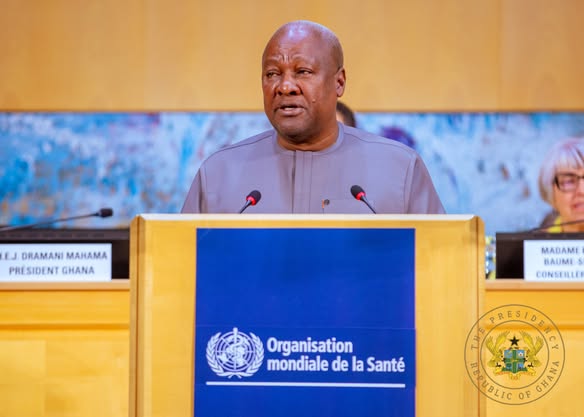
President John Dramani Mahama has announced that Ghana is on track to exit financial support from GAVI, the global vaccine alliance, by 2030.
Speaking at the 79th World Health Assembly in Geneva on Monday, May 18, President Mahama said Ghana’s growing capacity in healthcare financing and vaccine delivery has placed the country in a strong position to gradually move away from donor-backed vaccine support and potentially become a contributing partner in the future.
Addressing delegates at the high-level gathering, the President highlighted ongoing efforts to strengthen Ghana’s healthcare system, particularly through the MahamaCares initiative, which aims to improve access to specialised and high-cost medical treatment for citizens.
“Mahamacares is ensuring that specialised high-cost care is not a privilege for just a few but a right for all. Ghana, I am also happy to report, is on track to exit GAVI funding for vaccines by the year 2030, and we hope to transition into a donor in the not-too-distant future,” he stated.
The President’s remarks formed part of a broader address focused on healthcare reforms, universal health coverage, and the need for greater health sovereignty among African countries during the World Health Organization’s annual assembly.
GAVI, officially known as the Vaccine Alliance, is a global public-private partnership that supports access to life-saving vaccines in low-income countries.
Over the years, the organization has supported Ghana’s immunization programmes by financing vaccines for diseases including measles, polio, pneumococcal infections, rotavirus, yellow fever, and human papillomavirus (HPV).
The alliance has also contributed to improving vaccine coverage and reducing child mortality in Ghana through technical support and partnerships with international health agencies.
Under GAVI’s transition framework, countries that record sustained economic growth and improved gross national income levels are gradually transitioned away from donor assistance and expected to independently fund their national immunization programmes.