




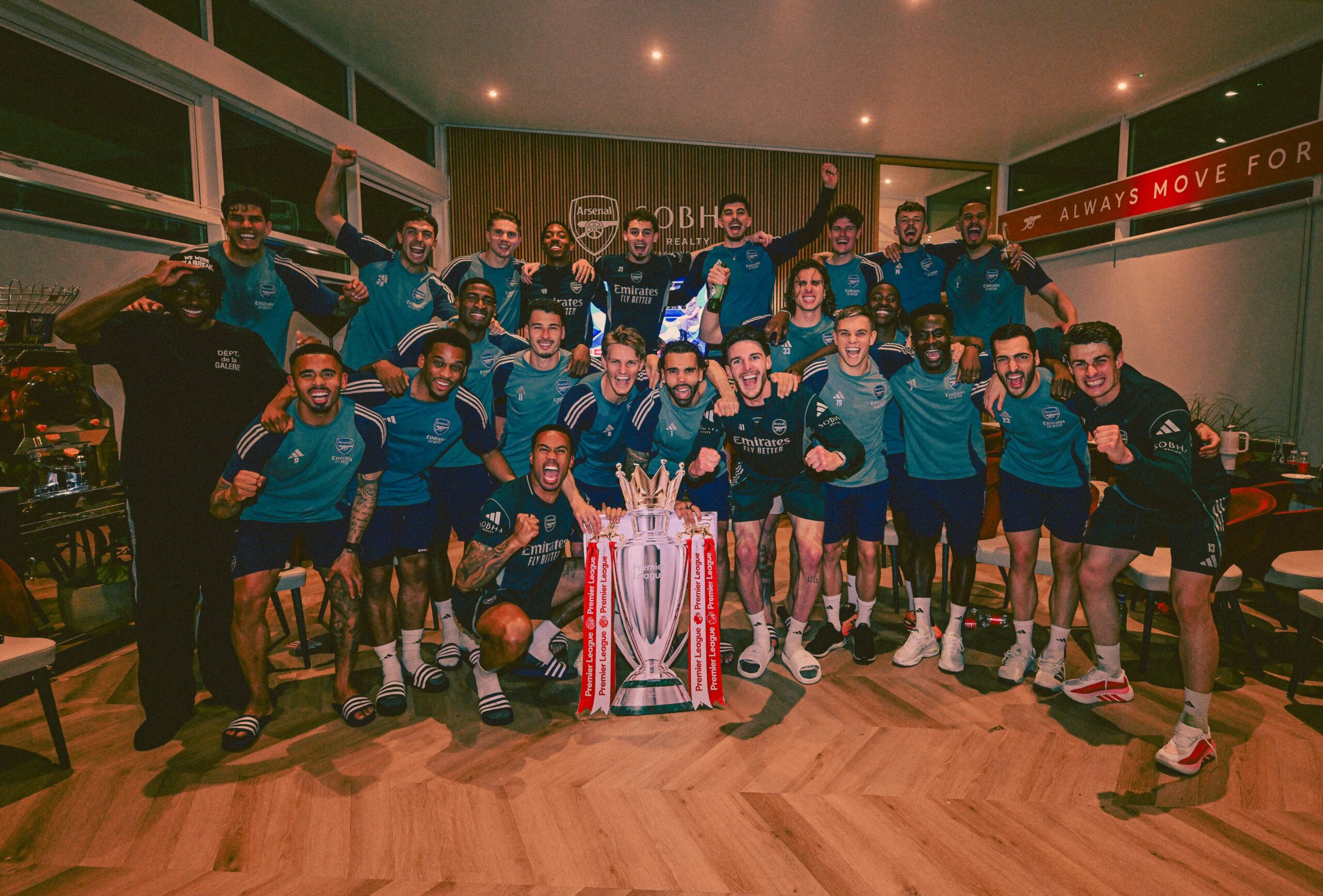
North London erupted as Arsenal were crowned Premier League champions for the first time in 22 years. Manchester City’s draw against Bournemouth finally confirmed what Arsenal fans had dreamed about for more than two decades, the title was coming back to the Emirates.
The moment arrived far from Arsenal’s home ground, but the celebrations felt deeply personal. Fans packed pubs around the Emirates Stadium, nervously watching Manchester City’s final push collapse on the south coast. When the final whistle blew at Bournemouth, cheers exploded across north London.
Inside Arsenal’s training ground, the players celebrated together. Staff and players danced, hugged, and sang “Campeones, Campeones, Ole Ole Ole!” as years of frustration disappeared in an instant. Declan Rice, who only weeks ago insisted “it’s not done,” summed up the feeling with a simple social media post: “It’s done.”
For Mikel Arteta, this was more than a trophy. It was validation after years of rebuilding, setbacks, and painful near misses. Arsenal had finished second in each of the last three seasons, watching Manchester City and Liverpool snatch titles away when pressure peaked.
This season felt different from the start. Arsenal invested heavily, bringing in Martín Zubimendi, Eberechi Eze, Noni Madueke, and Viktor Gyökeres in a bid to finally get over the line. The squad looked stronger, deeper, and mentally tougher.
The Gunners set the tone early by beating Manchester United on the opening day. By October, they reclaimed top spot and rarely let go. Across the campaign, Arsenal spent 234 days at the summit, proof of both consistency and resilience.
Arteta’s side were not always flashy, but they were relentless. Their set-piece dominance became one of the league’s biggest weapons. Arsenal scored 35 goals from dead-ball situations in all competitions, more than any club across Europe’s top five leagues over the last decade.
Critics compared them to Arsène Wenger’s “Invincibles,” but this team forged its own identity. Instead of free-flowing artistry, Arsenal thrived through organisation, physical strength, and defensive discipline. David Raya’s third straight Golden Glove award highlighted the platform behind their success.
There were moments when the dream nearly slipped away again. Defeats against Bournemouth and Manchester City in April reopened old wounds and invited memories of previous collapses. Yet unlike past campaigns, Arsenal responded with calm authority.
The narrow 1-0 win over Burnley proved decisive. It placed the pressure squarely on City, who could only manage a draw against Bournemouth. Pep Guardiola’s side, dominant for years, finally lost their grip on English football.
There is also a sense that this title could mark a changing of the guard. Reports suggest Guardiola may leave City at the end of the season, potentially closing one of the Premier League’s greatest eras. Arteta, once Guardiola’s assistant, now stands as the manager who dethroned his mentor.
Former goalkeeper Paul Robinson praised Arsenal’s patience with Arteta. “The best gift you can give a good manager is time,” he said in an interview. “You give a good manager time? There’s the proof.”
And now, with a Champions League final against Paris Saint-Germain still to come, Arsenal’s story may not yet be complete.