


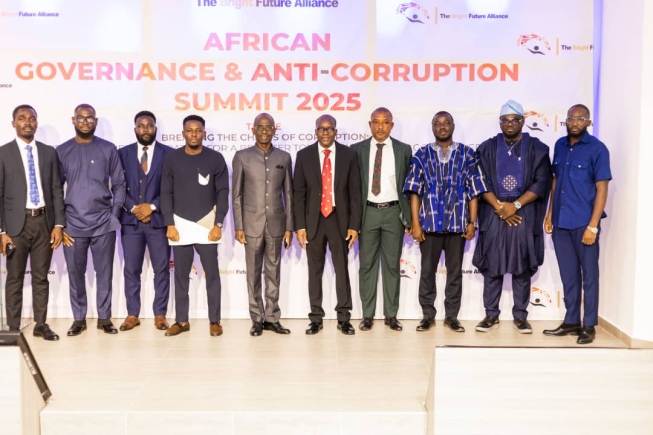
The Bright Future Alliance (TBFA) is raising fresh concerns about the lack of transparency in political party financing, warning that the current system leaves Ghana vulnerable to state capture.
The group made the call in a statement titled “Who Funds Our Politics? The Urgent Need for Transparency in Political Party Financing to Curb State Capture.”
According to TBFA, Ghana’s vibrant election seasons often mask the reality of undisclosed financial dealings that influence political decisions. The organisation described the situation as a “shadow economy,” noting that “beneath the veneer of competitive politics lies a deep and dangerous shadow economy… where the very sovereignty of our state is put up for auction.”
The group said one of the major challenges is the flow of undeclared campaign contributions directly to political actors rather than through official party accounts.
It observed that some donations “may not even touch the party’s official accounts” but instead end up in the personal “war chest” of presidential candidates, running mates or influential party executives. TBFA argued that such arrangements often translate into obligations that are later fulfilled through public contracts, regulatory decisions or political appointments.
TBFA also criticised the current Political Parties Act, 2000 (Act 574), describing it as inadequate for addressing modern political financing practices. The group said the law pays attention only to party structures and fails to account for individuals who operate separate financial channels.
It stated that “the law is blind to the reality that these figures often operate parallel financial ecosystems,” adding that weak enforcement has allowed questionable financing to go unchecked.
In the statement, the Alliance also linked opaque financing to poor development outcomes, citing issues such as substandard infrastructure and the protection of illegal mining activities by politically connected individuals.
The organisation is therefore calling for a more comprehensive political financing law that would require public disclosure of donations, introduce strict limits on how much individuals and organisations can contribute, and establish an independent body with powers to audit campaign finances and apply sanctions.
TBFA believes such reforms are necessary to safeguard Ghana’s democracy. It concluded its statement by noting that “the fight for transparency in political financing is the defining battle for the soul of Ghana’s Fourth Republic.”
READ FULL STATEMENT HERE
WHO FUNDS OUR POLITICS? THE URGENT NEED FOR TRANSPARENCY IN POLITICAL PARTY FINANCING TO CURB STATE CAPTURE
By The Bright Future Alliance (TBFA)
Every four years, Ghana’s political landscape erupts in a vibrant, costly spectacle of democracy. Rallies swell with colour, airwaves hum with party jingles, and convoys of branded vehicles crisscross the nation. Yet, beneath this veneer of competitive politics lies a deep and dangerous shadow economy, a transactional marketplace where the very sovereignty of our state is put up for auction.
The most critical question facing our republic today is not just who will win the next election, but rather, who is funding it, and crucially, through whom is this funding being channelled? The persistent and deliberate opacity of political financing is the foundational pillar upon which state capture is built, systematically converting private wealth into public policy and national debt.
State capture is not the crude, petty bribery of a public official. It is a far more insidious and systemic form of corruption where private interests fundamentally reshape the laws, policies, and institutions of the state to serve their own commercial advantage. In Ghana, this process begins with a secret donation. An individual, a corporation, or a syndicate makes a substantial, undeclared financial contribution.
However, this contribution may not even touch the party’s official accounts. Instead, it flows discreetly into the personal “war chest” of a presidential candidate, a running mate, or a powerful party secretary. This is not an act of civic benevolence; it is a strategic, personal investment in a future leader. When that party assumes power, the unrecorded debt, now a matter of personal obligation, is called in.
The returns on this investment are disbursed through the machinery of the state itself: inflated public procurement contracts awarded without fair competition, lucrative tax exemptions, the deliberate weakening of regulatory oversight in sectors like mining or finance, and the appointment of proxies to the boards of state-owned enterprises.
The financier becomes a silent, unelected puppeteer, pulling the strings of governance to the detriment of the public good. By funding key individuals directly, they bypass the institutional facade of the party and purchase a direct, personal line of influence with the future leaders of the country. These political figures, in turn, become conduits for illicit funds, blurring the lines between personal wealth, campaign finance, and party resources.
The current legal framework, the Political Parties Act, 2000 (Act 574), is tragically inadequate for confronting this modern threat. Its most glaring flaw is its institutional myopia; it treats political parties as monolithic entities, utterly failing to recognize that in modern Ghanaian politics, financial power is concentrated in key individuals.
While Article 55(14) of the 1992 Constitution laudably requires parties to declare their revenue sources, Act 574 provides no mechanism to scrutinize the finances of a flag bearer, their running mate, or the party chairman. The law is blind to the reality that these figures often operate parallel financial ecosystems, separate from the party’s formal accounts, where the most significant transactions of influence-peddling occur. The Act’s provisions are retrospective, not preventative, and the Electoral Commission has historically demonstrated neither the capacity nor the political will to conduct forensic audits, rendering the entire framework toothless.
The tangible cost of this failure is etched into the daily lives of every Ghanaian. It is the shoddily constructed road that washes away after one rainy season because the contract was awarded to a personal benefactor of a high-ranking official. It is the under-equipped hospital struggling to save lives because its procurement budget was siphoned off. It is the destruction of our water bodies by illegal miners shielded by the very political actors they bankrolled. State capture starves our nation of development, stifles innovation, and erodes public trust in democracy itself, fostering a deep-seated cynicism that governance is merely a contest between competing criminal enterprises.
To reclaim our democracy, The Bright Future Alliance calls for the immediate passage and enforcement of a new, robust Political Party and Campaign Finance Law. This is a prerequisite for our nation’s survival. A credible law must be built on three non-negotiable, holistic pillars:
First, Radical and Comprehensive Transparency. The law must mandate a publicly accessible, online portal where all donations- both cash and in-kind- above a minimal threshold (e.g., GHS 10,000) are declared in real-time. This disclosure must apply not only to the registered political party but also, crucially, to its principal actors: presidential and vice-presidential candidates, national chairpersons, and general secretaries, from the moment they declare their intent to run. Anonymity must be illegal.
Second, Enforceable and Aggregated Contribution Caps. To prevent any single entity from wielding disproportionate influence, strict limits must be placed on the aggregate amount an individual or corporation can donate across the entire political ecosystem- to the party, its presidential candidate, and its key executives combined. This closes the dangerous loophole of a single financier funding multiple power centres within the same party.
Third, an Independent Regulator with Expansive Sanctioning Power. A new, specialized body, must be given the constitutional and financial independence to enforce this law without fear or favour. It must be empowered to conduct forensic audits not only of party accounts but also of the declared assets and campaign finances of these designated key individuals, imposing crippling penalties and seeking disqualification for non-compliance.
The fight for transparency in political financing is the defining battle for the soul of Ghana’s fourth republic. Until we drag these shadowy transactions- both institutional and personal- into the disinfecting light of public scrutiny, our policies will continue to be written by and for the few, our resources will continue to be plundered, and our elections will remain a contest to determine which set of patrons gets to control the state.
The time for incremental reform is over. We must act now, decisively, to ensure that the voice of the Ghanaian citizen, not the wallet of the secret financier, is what truly matters in the corridors of power.
The Bright Future Alliance (TBFA) is a youth-led organization dedicated to promoting good governance, anti-economic crime, youth empowerment, and sustainable development in Africa.
Written by
Frank Quaye
Partnership Lead, TBFA.