




Ghana has recorded a marginal improvement in its performance on the global Corruption Perception Index (CPI), moving from a score of 42 in 2024 to 43 in the 2025 rankings.
The development was disclosed in a press release issued on February 10 by Transparency International.
According to the report, Ghana scored 43 out of a possible 100, placing the country 76th out of 182 countries assessed in the 2025 CPI. Despite the one-point increase, Transparency International noted that the change does not constitute a significant improvement under the CPI methodology.
The report indicated that Ghana continues to grapple with persistent corruption challenges, including weak compliance with and enforcement of existing legal and policy frameworks, as well as ineffective state institutions mandated to combat corruption.
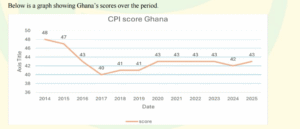
Transparency International further revealed that Ghana’s CPI score has largely stagnated in recent years. After maintaining a score of 43 from 2020, the country slipped to 42 in 2024 before returning to 43 in 2025.
The Ghana Integrity Initiative (GII), the local chapter of Transparency International, noted that Ghana’s highest CPI score was recorded in 2014, when the country scored 48 out of 100. Since then, Ghana experienced a steady decline until 2018. However, the formation of a new government at the time sparked renewed optimism, resulting in a slight improvement from a score of 40 in 2017 to 41 in both 2018 and 2019. Since then, Ghana’s CPI score has hovered around 43.
Transparency International’s data suggests that despite the introduction of several policy interventions and institutional reforms, Ghana continues to face significant obstacles in effectively addressing corruption.
In response to the country’s CPI performance, the GII has proposed a number of recommendations aimed at strengthening anti-corruption efforts and improving governance structures. These include legislative, judicial, and executive reforms.
Among the recommendations, Transparency International called on Ghana to strengthen its justice system and safeguard judicial independence. It also welcomed the Chief Justice’s decision to fast-track the establishment of specialised anti-corruption courts to ensure the speedy adjudication of corruption-related cases.
The organisation further advocated for a cultural reorientation towards ethical conduct, citing the Inspector-General of Police’s initiative to promote personnel who demonstrate integrity in the line of duty as a positive step.






, moving from a score of 42 in 2024 to 43 in the 2025 rankings.)