






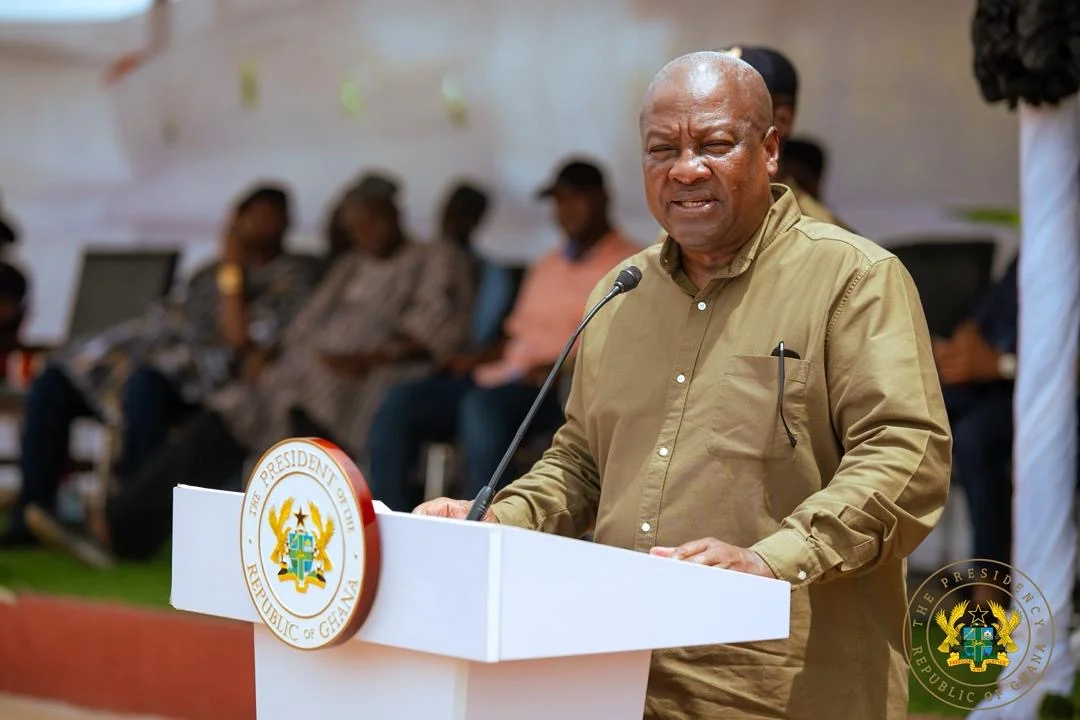
President John Dramani Mahama has expressed confidence in a more stable power supply across the country as government intensifies efforts to improve electricity delivery.
His remarks followed a visit to the Northern Electricity Distribution Company (NEDCo) on Sunday, April 19, 2026, as part of his “Resetting Ghana” tour. During the visit, the President inspected transformers being deployed under a nationwide upgrade programme aimed at strengthening the electricity distribution network.
According to President Mahama, approximately 2,500 transformers have been procured and are currently being installed as part of the first phase of the intervention. He explained that the initiative is focused on replacing old and faulty transformers to improve the quality, efficiency, and reliability of power supply across the country.
The President noted that the programme will be rolled out in phases, with subsequent installations expected to further enhance the resilience of the national grid and reduce the frequency of outages.
Touching on recent power interruptions experienced in parts of the country, President Mahama assured Ghanaians that the outages are temporary and linked to ongoing technical works to upgrade the system.
He emphasised that the situation does not signal a return to the prolonged power challenges—commonly referred to as “dumsor”—that previously affected the country, but rather reflects short-term disruptions necessary to achieve long-term stability.
The transformer installation forms part of a broader government strategy to modernise Ghana’s power infrastructure and meet growing energy demands driven by population growth and industrial activity.
Energy sector stakeholders have long identified ageing infrastructure and distribution inefficiencies as key contributors to inconsistent power supply, making such interventions critical to ensuring sustainable electricity delivery.
With the ongoing upgrades, government remains optimistic that the country is on course toward achieving a more reliable and stable power supply, easing concerns among households and businesses.